HVAC SEO in Ontario: What Good SEO Actually Includes, What It Costs, and How to Know It’s Working
If you’re paying for HVAC SEO in Ontario, you should know exactly what you’re buying without needing a marketing dictionary.
Most owners we talk to don’t actually doubt that marketing works. They doubt whether the money they’re already spending is doing anything, and “SEO” is one of the worst offenders: a term agencies throw around like everyone already knows what’s inside it. Good SEO gets the right homeowners to find you when they’re already searching for furnace repair, AC service, heat pumps and no-heat calls. The problem is that “SEO” can mean almost anything on a proposal. One company charges a few hundred a month for basic maintenance. Another charges several thousand for rebuilding pages, fixing technical issues, running your Business Profile and tracking which searches turn into calls. Same word, different jobs.
SEO is also just one piece of how people find and choose you. It’s not your website, your ads or what happens after someone calls, those are worth understanding on their own, and we’ll cover each one in this series.
The cheapest option isn’t automatically bad. The priciest isn’t automatically good. What matters is whether you can answer three questions:
- What are they actually doing?
- What business result is that work supposed to improve?
- How will you know if it’s producing real opportunities?
If nobody can answer those clearly, start asking questions.
Google’s own guidance is blunt: there’s no secret trick that guarantees the top spot. That’s a useful filter, it cuts through a lot of sales theatre.
This guide breaks down what HVAC SEO actually means, what good SEO includes, what it costs, and how to tell if it’s working, or if you’re just paying for a report.
Jump to:
- What HVAC SEO Actually Means
- What Good SEO Should Include
- What It Costs in Ontario
- Is Now the Right Time for It?
- How to Know If It’s Working
- Red Flags to Watch For
- Frequently Asked Questions
What Does HVAC SEO Actually Mean?
HVAC SEO is the work that gets your company in front of people searching Google for the services you offer. That’s the actual definition, and it’s shorter than most agencies make it sound.
The confusion isn’t an accident. “SEO” gets used as a catch-all for a dozen different tasks, and most owners nod along in sales calls without ever getting a plain-language answer. Four things have to be true for it to work:
- Your website makes it obvious what you do.
- Google can crawl and understand the site.
- Your Google Business Profile is accurate.
- You’ve built enough trust and local authority to beat the other HVAC companies in your area.
Ranking isn’t the goal. Getting the right homeowner to find you, trust you and call is the goal.
Local SEO vs. traditional SEO
HVAC is a local search business. Someone with a dead furnace in January isn’t looking for the world’s foremost expert on furnaces, they want somebody who can show up at the house. Their searches look like “furnace repair Burlington,” “AC repair Mississauga” or “furnace technician near me.”
Google ranks local results mainly on relevance, distance and prominence: does your business match the search, how close is your location, and do you look trusted. Nobody can legitimately sell you a guaranteed #1 Maps spot, or make Google believe your Hamilton shop is closer to Mississauga than it is. What you can do is give Google a clear, consistent picture of who you are and whether customers trust you.
SEO doesn’t mean stuffing in more keywords
Old-school SEO produced pages like “Looking for the best furnace repair Toronto furnace repair company for Toronto furnace repairs?” That’s not a strategy. It’s a hostage note with a phone number.
Modern SEO still cares what people search for, but keywords are one piece. A real program covers technical work, service pages, Business Profile management, content, reviews, links and tracking. Google pushes helpful, original, experience-led content: real depth, not filler.
Your strongest content already exists inside the business: the questions homeowners ask at the kitchen table, what your techs see every week, how heat pumps handle a Southern Ontario cold snap, when a repair still makes sense. That kind of content is harder to fake than another generic “5 Tips for Winter” post.
What Should Good HVAC SEO Include?
Good HVAC SEO includes a technically sound website, strong service pages, an actively managed Google Business Profile, real reviews, useful local content, genuine authority signals, smart location pages and tracking that goes past rankings. Here’s what each piece actually means for an owner-operated company in Southern Ontario:
1. A technically sound website
Before anything else, make sure Google can actually crawl and understand the site you’ve got:
- Crawlable, indexed pages with no broken links or bad redirects
- Fast load times and solid mobile usability
- HTTPS and basic security
- A logical structure for services and locations, with clear titles and headings
- Structured data where it genuinely helps
- Search Console, analytics and call/form tracking connected
Technical SEO doesn’t book jobs by itself. Think of it as clearing mechanical drag, a great furnace page won’t matter if Google can’t find it or the contact button’s broken.
2. Strong pages for the services you actually want
“Heating and cooling services” on your homepage doesn’t explain your business. Furnace repair, replacement, AC, heat pumps, ductless, boilers, maintenance, commercial: each real part of your business deserves its own page answering what a customer wants to know before they call (equipment, symptoms, what’s included, service area, warranties, next step).
Google doesn’t have a preferred word count. The goal’s usefulness, not length. Fewer strong pages beat fifty thin ones built off a keyword spreadsheet.
3. A properly managed Google Business Profile
For most HVAC searches, the Maps results get seen before your website does. Your profile needs to accurately show:
- Business name and correct categories
- Phone number and hours, including seasonal changes
- Services offered
- Real photos of your team and trucks
- Legitimate service areas
- Active responses to reviews
If you don’t serve customers at your address, Google says to hide it and list service areas instead: up to 20, generally within two hours of your base, one profile per staffed location. A rented mailbox isn’t a shortcut to five extra map listings; if anyone suggests faking locations to “dominate the map,” walk away.
4. Reviews and reputation
Reviews aren’t decoration next to the star rating. Review volume and rating contribute to local prominence, and homeowners use them to decide who to call. A contractor with 260 recent, detailed reviews and thoughtful replies beats one sitting on 42 reviews from last summer, even if both rank the same.
Ask happy customers for reviews consistently, make it easy and respond like a real business. Don’t fake or buy reviews, and don’t turn your techs into hostage negotiators for five stars.
5. Useful local content
You don’t need a blog because someone told you Google likes blogs. You need pages that answer real questions your customers already ask, with something only your business can add: whether a heat pump makes sense for a given Ontario home, repair-versus-replace calls, what certain furnace symptoms mean, how equipment choices differ between a century home and a new subdivision.
If your techs explain the same thing to customers every week, you’ve got the seed of an article.
6. Local authority, links and location pages
“Build backlinks” is too vague to mean anything. Real authority comes from industry associations, suppliers, manufacturers, sponsorships and local partnerships that make sense outside of SEO. TSSA registration and HRAI membership are real Ontario credentials worth explaining and linking to, that beats a “#1 Most Trusted” badge made in Canva.
City pages work the same way. If you serve Hamilton, Burlington and Oakville, each page needs to say something real about that market, not just swap the city name. Google’s spam policies call out exactly this: near-identical city pages built to capture search traffic. If your plan calls for 75 location pages before your core furnace, AC and heat pump pages are solid, ask why.
7. Tracking that goes past rankings
Moving from position 17 to 6 for “furnace repair Hamilton” is a good sign, but it doesn’t tell you if anyone hired you. Push your reporting further down this list:
- Organic visibility and Business Profile actions
- Traffic to service pages
- Phone clicks, form starts and completions
- Qualified inquiries and booked appointments
- Revenue, where your CRM makes attribution possible
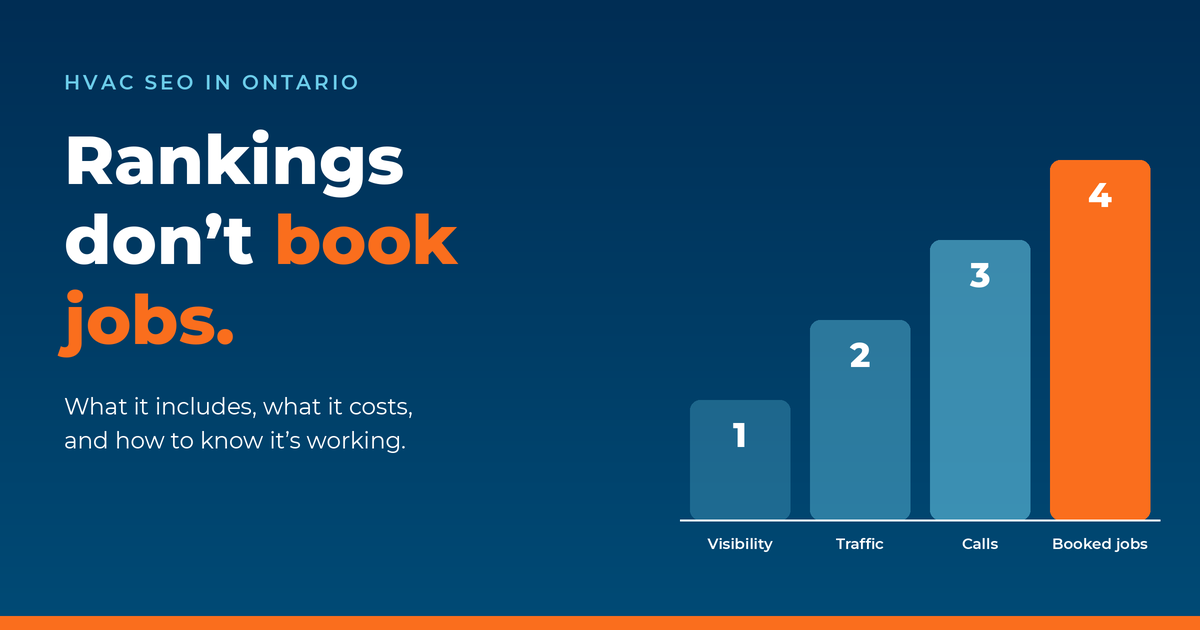
Rankings prove SEO might be working. Booked jobs prove the business is benefiting.
How Much Does HVAC SEO Cost in Ontario?
There’s no regulated price and no single “correct” fee. Legit quotes run from a few hundred dollars a month to several thousand, depending on your market, scope and how much real work is involved.
A 2024 Ahrefs survey of 439 providers found local SEO averaging US$1,557 a month, with 79.1% of U.S./Canada respondents charging at least US$1,001. Not an Ontario rate card, but useful context.
If you’ve got a $200-a-month quote in hand, here’s the honest read: that usually buys monitoring and the occasional small tweak, upkeep, not a campaign. That’s a fine purchase if you already have a strong site in a quiet market. It won’t out-rank three serious competitors in Hamilton. Neither price is wrong on its own, they’re just not the same purchase.
Don’t treat price as proof of quality. Look at what each budget actually funds:
| Monthly budget | What it typically funds |
|---|---|
| Under ~$500 | Monitoring, basic Business Profile updates, small site tweaks, occasional content |
| ~$750 to $1,500 | Technical fixes, page improvements, limited content, some outreach and reporting |
| ~$1,500 to $3,500 | Deeper technical work, ongoing content, authority building, conversion tracking, regular strategy |
| $3,500 and up | Multiple locations, a big footprint, or a deliberate bet on organic as a growth channel |
A $5,000 invoice doesn’t prove $5,000 of billable hours happened. These are planning ranges, not a price list, the mix of work matters more than the number.
Why Can Two HVAC SEO Quotes Be $300 and $3,000?
Price is the easiest number to compare and the least useful by itself. Compare the work instead. Ask each provider:
- What will you actually do in the first 90 days, and every month after?
- Who does the work, and who writes or reviews content?
- Do you make site changes, or just send recommendations?
- Is Google Business Profile work included?
- How do you approach reviews, links and local mentions?
- How will calls and forms get tracked, and what does the monthly report show?
- Who owns the domain, site, analytics, GBP and ad accounts?
- What happens to the work if we stop?
If one company’s offering four hours of maintenance and another’s assigning a strategist, writer and developer, the price gap stops looking mysterious. If the $3,000 provider can’t explain their work beyond “content, backlinks and optimization,” keep asking.
On commitment: real SEO work needs some runway to show results, so a minimum term of three to six months is normal. Month-to-month after that is a reasonable ask. What’s not reasonable is a contract that locks you in for a year with no visibility into what’s happening in month four.
How Long Does HVAC SEO Take to Work?
Months, not days. Any provider promising instant rankings should make you nervous.
SEO is an asset you build, not a vending machine, you don’t put a dollar amount in and get a fixed number of calls out the other end next Tuesday. Some things move fast: fixing tracking, a broken page or your Business Profile can happen in days or weeks. The business result (competitive rankings, authority, consistent inquiries) takes longer, depending on your starting point and how strong your competitors already are.
There’s a difference between work completed and results earned. Some months you’ll pay and the phone won’t ring any more than it did last month. That’s not automatically wasted money, technical fixes and content take time to compound, but your provider should still be able to show you the actual work behind a quiet month, not just ask you to trust the process. A good early report shows pages rebuilt, tracking fixed, indexing issues resolved and new content live, even when it’s too early to call the final result.
How Do You Know If It’s Working?
Judge it in layers.
Level 1: Are you more visible? Search impressions, Maps visibility, rankings for money-keywords, branded searches. Tells you Google’s showing you more, not that anyone hired you.
Level 2: Are the right people reaching your site? Organic traffic to service pages, visits from your service area, GBP clicks, phone-button clicks, form starts. Ten thousand visits from outside Ontario looks great on a chart, does nothing for the board.
Level 3: Are those visits becoming real opportunities? Calls from organic search, valid inquiries, quote requests, booked appointments, no-heat/no-cool calls, replacement conversations. A spam form from an overseas solar company isn’t a lead. A Burlington homeowner asking about a furnace replacement is.
Level 4: Is it turning into profitable work? Where your systems allow it: booked jobs, average job value, gross profit, repeat maintenance work. Attribution’s never perfect, but you don’t need accounting-grade certainty. You need enough to make better decisions.
Say a Burlington company moves from page two to the map pack for “furnace repair Burlington.” That’s Level 1, real, and worth noting. If the phone doesn’t ring any more than before, or the calls that do come in never get booked, the SEO “worked” and the business still didn’t feel it, which is exactly why the levels below rankings matter more.
If visibility’s climbing but qualified calls aren’t, dig into that. If calls are climbing but bookings aren’t, the problem’s probably not SEO anymore.
The Part No SEO Company Can Control
SEO gets the homeowner to find you. It can’t make anyone answer the phone. Google Ads can create the call. It can’t get the callback returned before the homeowner tries the next company.
We called 191 HVAC companies across Southern Ontario during business hours. 56 never answered the phone. Of those, 22 got a callback that recovered the conversation and 34 never heard back at all. That doesn’t mean every one of the 34 became a lost job, but it proves getting found and capturing the opportunity are two different jobs, and that the leak is fixable.
Before you buy more leads, fix what happens to the ones you have.
That doesn’t make SEO unnecessary, it’s one half of the handoff: you need people to find you, and you need the business to respond, quote and book the work. More traffic into a leaky process just makes a more expensive leak.
When Is SEO Not the Right First Investment?
SEO isn’t automatically the first thing to buy. Whether it’s the right move right now comes down to how established you are, how competitive your market is, and what a booked job is actually worth to you, not just whether you feel “ready.”
- You need work next week. Two empty days on the board? Organic SEO isn’t the fastest lever, referrals, seasonal follow-up or Google Ads move faster.
- Your basics are broken. Site doesn’t work on a phone, wrong number listed, unverified profile, no real service pages? Fix the foundation before signing a content package.
- You’re already missing calls. Sending more traffic into a process that’s already dropping opportunities won’t help. Fix the leak, then add more water.
- You can’t handle more demand. Techs booked solid, callbacks climbing and dispatch already backed up? More lead volume just means more windshield time and a worse customer experience. Fix dispatch, pricing or capacity first.
- You’re only getting a call or two a day. That’s not automatically an SEO problem. Check your Business Profile views and search impressions first: if people are already seeing you and not calling, the fix is somewhere else. If nobody’s seeing you at all, that’s SEO’s lane.
SEO or Google Ads?
Neither’s automatically better. Ads buy visibility now. SEO earns it over time.
Launching a new company and need calls fast? Paid search buys faster feedback while the organic foundation builds. Established, good reputation, weak visibility? SEO’s probably the gap. Most healthy HVAC companies eventually run both.
The real question isn’t which channel’s better. It’s the economics: what you’re paying per opportunity, how many become booked jobs, and where’s the leak between the click and the invoice.
What Are the Red Flags When Hiring an HVAC SEO Company?
No single flag proves a company’s bad. Several together should slow you down. Be cautious if a provider:
- Guarantees a #1 Google or Maps ranking
- Can’t explain what work happens each month
- Wants control of your domain or accounts with no ownership terms
- Recommends fake Google locations or virtual offices
- Plans hundreds of near-identical city pages
- Reports only rankings, never calls or inquiries
- Talks about “proprietary methods” but can’t explain the work in plain English
- Sells backlinks by volume without discussing quality or risk
- Can’t show what actually changed on the site
A long contract isn’t automatically a red flag, real work needs runway. The problem is no clear scope, no ownership clarity and no accountability. Know what you’re agreeing to, what you keep if you leave and what success gets measured against.
What Should You Expect From a Good HVAC SEO Partner?
A good provider explains the account without jargon. You should always get clear answers to:
- Where are we now?
- What’s holding visibility back?
- What are you fixing first, and why?
- What did you actually do this month, and what are you watching?
- What’s improving, what isn’t, and what’s next?
You don’t need every technical detail. You need enough visibility to judge whether real work’s happening, like a specialist explaining what’s broken, what they fixed and what the gauges say now.
Before You Spend More on SEO, Check What Happens After the Lead Arrives
Good SEO gets more of the right homeowners to find you. But marketing’s only done its job once the opportunity reaches your business, and that’s where revenue disappears: a missed no-heat call, a quote nobody follows up on, a happy customer never asked for a review.
That’s what HVAC Lead Rescue focuses on, and the first fix is usually the simplest one: you can’t book the jobs you never answer. Missed Call Text-Back replies the moment a call goes unanswered, so the conversation stays warm while you’re still finishing the last job. Before you increase the marketing budget, check whether calls, inquiries, quotes, past customers and reviews are getting handled consistently.
Book your free 15-minute HVAC Revenue Leak Review
In 15 minutes, we’ll look at how your business handles new calls, quotes, past customers and reviews. You’ll leave with a simple red, yellow and green score showing where opportunities are slipping through and what to fix first.
HVAC SEO Ontario: Frequently Asked Questions
How much does HVAC SEO cost in Ontario?
Pricing varies by market, competition, site condition and scope, from a few hundred dollars a month for maintenance to several thousand for active, competitive SEO. Compare scope and accountability before you compare price.
How long does HVAC SEO take to work?
Months, not days. Technical fixes happen fast, competitive visibility and consistent inquiries take longer. There’s no honest universal timeline or guaranteed ranking date.
What if I pay for a month and nothing happens?
Some months won’t show a jump in calls. That’s normal for an asset-building channel, not proof the money’s wasted. Ask your provider exactly what got done that month, then judge the results over a full quarter, not a single invoice.
Is SEO worth it for a small HVAC company?
Often, yes, if homeowners already search for what you offer and you’ll serve the market for years. It’s a lower priority if you need work immediately or can’t yet answer the inquiries you already get.
Can an HVAC company do SEO itself?
Parts of it. An owner or office manager can keep the Business Profile accurate, ask for reviews and keep service pages honest. Technical SEO, strategy and competitive link work usually need specialist help.
Is Google Business Profile part of HVAC SEO?
Yes. It’s a major part of local visibility. Complete information, links and reviews all contribute to how you show up locally.
Should an HVAC company use SEO or Google Ads?
Depends on timing and economics. Ads create visibility now as long as you keep paying; SEO builds it over time. Many established companies use both.
How do I know if my SEO company’s actually doing anything?
Ask for a plain-language record of what changed, then watch whether visibility, qualified calls and booked opportunities improve. “SEO takes time” should never mean “we can’t show you what we did.”