By the end of this, you’ll know exactly what Google Local Services Ads are, what you’re actually paying for, what a lead really costs, and why some shops pay for leads that never turn into a single booked job.
Here’s the fear most owners won’t say out loud. You’ve heard “LSA,” “Google Guaranteed” and “pay per lead” from a Google rep or an agency, and nobody’s given you a straight answer. You’re worried about paying for junk calls. You don’t know why a competitor sits above you. You’ve already been burned by a lead platform that sold the same homeowner to five companies. And underneath all of it: you don’t want to spend money on something you can’t measure.
That’s a reasonable fear. So let’s take it apart.
LSA is one piece of how people find and choose you. It’s not your SEO, your website, your Google reviews or what happens after someone calls; those are worth understanding on their own, and we cover each one in this series. If you want the big picture first, start with our overview of digital marketing for plumbing and HVAC companies.
Gut check: three questions to ask about any LSA manager or pay-per-lead spend
- Can you tell me what each booked job cost me last month, not just each lead?
- When a lead is junk, who flags it, and what actually happens next?
- If I stop paying tomorrow, what do I still own?
If nobody can answer those, the problem isn’t Google. It’s the setup.
We’ll lean on Google’s own Local Services help documentation throughout, because it explains how leads are charged, how ranking works and how lead credits work in plainer terms than most sales pitches do.
This guide covers what LSA is, what the badge means in Canada, what it costs, how bad leads are handled, how ranking works, how to measure it, and how to decide whether it’s the right spend for your shop right now.
Jump to:
- What are Google Local Services Ads, and how are they different from regular Google Ads?
- What does the Google Verified badge mean for a plumbing or HVAC company in Canada?
- What does good Local Services Ads management include?
- How much do Google Local Services Ads cost in Ontario?
- What counts as a bad LSA lead, and can you get credited for it?
- Why do LSA management quotes vary so much?
- How fast do Local Services Ads produce results?
- What affects your ranking in Local Services Ads?
- How do you know if Local Services Ads are working?
- What can’t Local Services Ads fix on their own?
- Are Local Services Ads the right first investment for your business right now?
- Local Services Ads vs. Google Search Ads vs. SEO: which one makes sense?
- What are the red flags when hiring someone to manage LSA?
- What can a good LSA partner always answer?
- What happens to the leads you’ve already paid for?
- Frequently asked questions about Google Local Services Ads
What are Google Local Services Ads, and how are they different from regular Google Ads?
Google Local Services Ads are pay-per-lead ads for service businesses that show your company name, rating, review count and verification badge at the top of Google for searches like “furnace repair near me” or “emergency plumber.” You pay when a homeowner contacts you through the ad, not when someone clicks.
That’s the big difference. Here’s how LSA sits next to the other things that show up on the same Google page:
| Local Services Ads | Google Search Ads | Google Business Profile / Maps pack | Organic SEO | |
|---|---|---|---|---|
| What it looks like | A profile card with your name, stars, reviews and badge | A text ad that links to your website | Your free listing on the map | Your website in the regular results |
| How you pay | Per lead (a call, message or booking) | Per click | Free | Free per click; you pay in time or an agency fee |
| Where the homeowner lands | Your LSA profile, then your phone | Your website | Your listing, then your phone or site | Your website |
| What you control | Service area, job types, hours, budget, bidding, responsiveness, reviews | Keywords, ad copy, landing page, bids | Profile details, photos, reviews, posts | Site content, local relevance, links |
| Stops when you stop paying? | Yes, immediately | Yes, immediately | No | No, but it fades if neglected |
A homeowner with no heat at 9 p.m. or water coming through the basement ceiling doesn’t care which box they’re tapping. They care who looks trustworthy and who picks up. LSA’s whole job is to put you in that first glance.
What does the Google Verified badge mean for a plumbing or HVAC company in Canada?
The Google Verified badge means your business passed Google’s screening checks, and it’s now the single badge Google uses on Local Services Ads. As of October 20, 2025, Google replaced three older badges (Google Guaranteed, Google Screened and License Verified by Google) with Google Verified.
So if a rep still pitches you “Google Guaranteed,” that’s an old name. Here’s what changed:
- One badge instead of several. Google’s help page on the Google Verified badge describes it as a single badge that replaces the older advertiser badges, with the specific checks you’ve passed listed on your profile.
- The money-back guarantee is going away. Google says it’s discontinuing the Money Back Guarantee that came with the old Google Guarantee badge. Homeowners can still request reimbursement for services booked through LSA before December 7, 2025, within 30 days of the job being done.
- Existing advertisers carried over. Businesses that already met the verification requirements received the new badge automatically.
What does the screening actually involve?
Google’s screening for plumbing and HVAC checks your business, your licences and your insurance, and Google treats both trades as urgent categories with extra screening of the people going into homes. Google’s general requirements page lists these items for both trades:
- Background checks on the business and the owner (Google marks these “select users only” for plumbing). Google treats both plumbing and HVAC as urgent categories, so both get an extra level of screening that includes background checks on service professionals.
- Business and owner licences, where local law requires them.
- Insurance, listed by Google as general liability and professional liability.
- Reviews, where the category requires them.
- Billing and budget setup.
Google’s help documentation flags some checks as “CA select users only,” which means not every Canadian business sees the same list. Your onboarding screen is the final word on what Google needs from you.
What does that look like for an Ontario shop?
For an Ontario plumbing or HVAC company, the paperwork Google wants usually maps onto credentials you already need to operate legally:
- Fuel-burning appliances: in Ontario, only contractors registered with the Technical Standards and Safety Authority (TSSA) and certified fuel technicians can legally install, service or maintain fuel-burning appliances like furnaces, boilers and water heaters. That covers HVAC shops and a lot of plumbing shops too.
- Plumbing: plumber (306A) is a compulsory trade in Ontario, so a plumber needs a Certificate of Qualification (or is a registered apprentice) to practise legally. Some municipalities also licence the business: the City of Toronto requires a Plumbing Contractor licence.
- Business registration and insurance: your provincial business registration and current liability insurance certificate.
Yes, it’s a hassle. It’s also the hassle that keeps the unlicensed guy with a van and a Kijiji ad off the top of the page.
Can you run ads before the badge is approved?
Yes. Google allows “pre-badge” ads while onboarding finishes, as long as you’ve submitted a licence or business registration, acknowledged you hold the right licences, met any review requirement and set up billing. Google says pre-badge listings show below providers who’ve completed onboarding and earned the badge.
What does good Local Services Ads management include?
Good LSA management covers nine things: profile and service setup, service area, job types, budget and bidding mode, hours that match when you actually answer, a review strategy, lead feedback and disputes, call answering and booking, and tracking every lead to a booked job.
Most “management” stops at the first four. The last five are where the money is.
1. Profile and service setup
Your profile is your storefront. Business name, bio, photos of your actual trucks and crew, and the right category (plumber, HVAC or both). Google says high-quality images and complete business information feed into profile quality, which affects ranking.
2. Service area
Draw the area you’ll actually drive to on a Tuesday afternoon, not the area you’d drive to for a $15,000 job. Every lead from a town you won’t service is a lead you pay for, and Google no longer credits leads for areas you don’t serve.
3. Job types
Turn on the jobs you want and turn off the ones you don’t. If you don’t do sewer camera work or ductless heat pumps, don’t advertise them. Google’s own help page says adjusting job types and service areas reduces unwanted leads, though it can also reduce volume.
4. Budget and bidding mode
Google offers three bidding modes: Maximize leads (Google sets bids to get the most leads for your budget), Target cost per lead (Google bids toward a per-lead target) and Max per lead (you set a ceiling). Google recommends a budget of roughly 10 leads per week for Maximize leads and says results take about two weeks to settle.
5. Hours that match when you actually answer
This one bites hard. Google charges for a missed call during business hours if the caller stays on the line more than 20 seconds, and Google counts the hours set in your Google Business Profile as your business hours. If your profile says you’re open until 8 p.m. and nobody answers after 5, you’re paying for calls that ring out.
6. Review strategy
Google lists your rating and number of reviews as part of profile quality. A steady flow of real reviews from real jobs is one of the few ranking levers you fully own. (We go deeper in our Google reviews guide for plumbing and HVAC companies.)
7. Lead feedback and disputes
Somebody has to look at every lead, rate it in the dashboard, and fill in Google’s lead feedback survey. Google uses that feedback and says leaving it can earn a bonus credit.
8. Call answering and booking
The ad gets the phone to ring. Whoever picks up decides whether it becomes a job. Message and booking leads need the same attention: a text that sits for four hours is a text the homeowner already sent to someone else.
9. Tracking
Every lead tied to an outcome: booked, quoted, lost, junk. Without that, you’re judging LSA by the cost per lead, which is like judging a tech by how many driveways he pulled into.
How much do Google Local Services Ads cost in Ontario?
You pay per lead, not per click, and the price of each lead depends on your trade, your town, the job type, the lead type and your bidding mode. There’s no verified public dataset of Ontario LSA lead costs, so the only reliable number for your market is the estimate Google shows you during setup and, after that, your own account data.
How are you charged?
Google charges when a homeowner contacts you through your ad. According to Google’s lead charging documentation:
- Phone calls are charged when you answer or call back and talk to the customer.
- Missed calls during business hours are charged if the caller stays on the line more than 20 seconds.
- Voicemails count as valid leads.
- Messages (text or email) are charged when you receive them, and Google says they’re usually priced lower than phone leads.
- Booking requests are a lead type available in the US and Canada.
- Repeat contacts from the same phone number or email aren’t charged again if there’s been interaction within 15 days. After 15 quiet days, a new contact can be charged as a new lead.
Read the second bullet twice. With LSA, a missed call isn’t just a lost job. It can be a lost job you paid for.
What drives the cost per lead?
Google says prices vary by location, job type, lead type and bidding mode. In practice, that means:
- Trade and job type: a furnace or AC replacement lead and a water heater replacement lead usually cost more than a small repair lead, because more companies want them.
- Town: a dense GTA suburb with twenty competitors and a smaller town with four behave differently.
- Season: the first cold snap fills every HVAC board in Southern Ontario at once, and spring thaw does the same for sump pumps and wet basements. More demand and more competitors bidding tends to push costs up.
- Profile quality: Google says higher-quality profiles may rank higher and pay a lower cost per lead.
How do budget and bidding work?
You set an average weekly budget. Google can spend more than that in a given week, but not more than your monthly maximum, which Google calculates as your weekly budget times the average number of weeks in a month. Once you hit the monthly maximum, your ads stop showing until the month resets or you raise the budget.
What are the directional numbers?
The most recent published range we could find comes from a Contractor Magazine article (August 2026) that combines LSA and Google Search Ads and is based on the author’s client accounts plus widely reported industry ranges:
| Trade | Directional cost per lead (LSA and Google Search Ads combined) |
|---|---|
| Plumbing | $25 to $75 per lead |
| HVAC | $30 to $90 per lead |
The article doesn’t state a country, sample size or method, and its figures read as US dollars. Treat them as a sanity check, not a forecast for Barrie or Burlington.
What does each budget level actually buy?
Here’s the math using that directional range and Google’s own guidance of about 10 leads a week for the Maximize leads mode. These are illustrations, not quotes.
| Weekly ad budget | Roughly what it buys at $30 to $90 a lead | Who it fits |
|---|---|---|
| Under $300 | About 3 to 10 leads a week | Testing a small service area, or a shop with thin capacity |
| $300 to $900 | About 10 leads a week at $30 to $90 a lead, the minimum Google recommends for Maximize leads | A shop that can answer, book and run those calls this week |
| $900 and up | 10 to 30 or more leads a week | Shops with dispatch capacity and someone answering every call |
And here’s how the management side usually breaks down:
| Management option | What you pay | What you get | Watch for |
|---|---|---|---|
| Do it yourself | Ad spend only | Full control and full responsibility | Nobody reviewing leads, rating junk or fixing hours |
| Flat monthly fee | Ad spend plus a set fee | Predictable cost; good ones handle setup, feedback and reporting | A fee that buys a monthly PDF and not much else |
| Percentage of ad spend | Ad spend plus a percentage | Manager earns more as you spend more | An incentive to raise your budget instead of your booked jobs |
| Bundled “leads included” plan | One combined number | Simple invoice | Not knowing what Google actually got versus what the agency kept |
What about cheap per-lead marketplace and directory leads?
Shared-lead marketplaces and directories are the lowest price anchor in this category, and they’re cheap for a reason: the same homeowner is often sold to several contractors at once. You’re not buying a customer. You’re buying a spot in a race. An LSA call rings your phone and only your phone, which is a big part of why it costs more. The cheaper the lead, the more the outcome depends on how fast you reply.
What counts as a bad LSA lead, and can you get credited for it?
A bad lead is any contact that was never a real chance at a job: spam, solicitors, wrong numbers, people looking for a service you don’t offer, or callers outside your area. Google screens leads automatically and doesn’t charge for the ones it judges invalid, but you can no longer dispute leads for being the wrong job type or outside your service area.
Here’s how Google’s lead credit policy works today:
- Screening at first contact. Google assesses every lead when the homeowner first reaches out. Invalid or low-quality leads aren’t charged.
- Automatic credits later. Charged leads are reassessed over time and may be credited automatically if Google later judges them low quality.
- Some junk still slips through. Google says it aims to catch bad leads, but some may be credited within the first 24 hours after the charge rather than blocked outright.
- No more credits for wrong job type or wrong area. Google says “job type not serviced” and “geo not serviced” credits are no longer supported. That’s why service area and job type setup matter so much.
- Credits take time. Credits usually post within 30 days, and the original charge still shows on the invoice.
- Your feedback counts. You can rate each lead with “Rate this lead” in the Leads section and submit the lead feedback survey, which Google says can earn a bonus credit.
In plain terms: Google catches a lot of the obvious junk on its own, and you’re on the hook for the rest unless your setup prevents it. The best lead dispute is the one you never have to file because your service area, job types and hours were set up right.
As for price shoppers: a homeowner asking what a water heater costs isn’t a bad lead. That’s a sales conversation. The ones who never book are usually the ones who never got a quote back.
Why do LSA management quotes vary so much?
Two LSA management quotes vary because they’re often quoting different jobs. One manager sets up your profile and sends a report. Another reviews every lead, rates the junk, fixes your hours, pushes reviews and tracks leads to booked work.
Before you sign anything, ask:
- Is ad spend separate from your fee, and will I see Google’s invoice directly?
- Who owns the LSA account if we part ways?
- How do you charge: flat fee, percentage of spend, or bundled?
- Who reviews and rates our leads each week?
- What do you report: leads, or booked jobs and revenue?
- How do you decide our service area and job types?
- What do you change when cost per lead goes up?
- Do you help with reviews, or just the ads?
- What do you need from us to make this work?
On commitment: ask for terms that let you leave if it isn’t working. Google says bidding takes about two weeks to settle, and a full season tells you more than one month, so a 90-day first look is reasonable. A 12-month lock-in for a channel that stops the moment you stop paying is a lot to ask.
How fast do Local Services Ads produce results?
LSA can produce leads as soon as your ads are approved and showing, because it’s paid placement and not an asset you build over time. Google says it takes about two weeks to see accurate results while bidding adjusts to your business.
Here’s the honest part. LSA is rented visibility. When the budget stops, the leads stop. It’s the closest thing to a vending machine in local marketing: money in, phone rings. That’s exactly why what happens after the lead arrives decides whether it pays.
The things you actually build while running LSA aren’t the ads. They’re your reviews, your response speed and your follow-up system. Those carry over to your Maps listing, your website, your Search Ads and every referral.
What if I pay and nothing happens this month?
If you pay and get few or no leads in a month, check four things first: your budget and bidding mode, your service area and job types, your hours versus when you actually answer, and your review count and responsiveness compared to competitors. If leads did come in but nothing booked, the problem is usually the reply and follow-up, not Google. Also check whether you hit your monthly maximum early, since Google stops showing your ad once you do.
What affects your ranking in Local Services Ads?
Google ranks Local Services Ads with an auction that weighs your bid against your profile quality and how likely you are to turn a search into a real lead. Responsiveness, reviews and relevance all matter, and Google says missed calls may negatively affect your responsiveness.
According to Google’s ranking documentation, here’s what’s in play and how much of it you control:
| Factor | What Google says | Can you control it? |
|---|---|---|
| Your bid | The most you’re willing to pay per lead; you may pay less | Yes |
| Responsiveness | Missed calls may negatively affect your responsiveness | Yes |
| Search context | The service searched, time of day and the searcher’s location | Partly, through service area and hours |
| Relevance | The services you offer and your business bio | Yes |
| Lead types | Turning on messages and bookings gives homeowners more ways to reach you, especially nights and weekends | Yes |
| Profile quality | Rating, number of reviews, average response time, images, completed verification checks | Mostly, over time |
| Ecosystem balance | Google aims to give all providers a fair chance | No |
Notice what isn’t on Google’s list: a secret handshake. A competitor sitting above you usually has more reviews, answers more calls or bids more.
Why do missed calls and slow replies cost twice with LSA?
Missed calls and slow replies cost twice with LSA because you can be charged for the missed call and your responsiveness can affect how often Google shows you afterward. A missed call during business hours is charged once the caller stays on the line more than 20 seconds, and Google lists responsiveness and average response time as ranking factors. So the missed call costs you the lead, and it can make the next lead harder to get. That’s the part nobody puts on the sales slide.
How do you know if Local Services Ads are working?
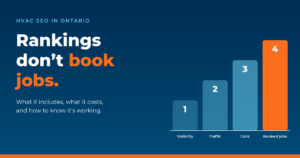
You know LSA is working when you can trace ad spend to booked jobs and revenue, not just to leads. Measure it in five levels, from what Google reports up to what hits your bank account.
| Level | What you measure | Where it lives | What it tells you |
|---|---|---|---|
| 1. Visibility | Impressions, where you show | LSA dashboard | Whether Google’s showing you at all |
| 2. Leads | Calls, messages, bookings, charged vs. credited | LSA dashboard | What you’re paying for |
| 3. Conversations | Leads answered or replied to, and how fast | Your phone system or CRM | Whether your team actually connected |
| 4. Booked jobs | Leads that turned into a job on the board | Your CRM or dispatch board | What each booked job cost you |
| 5. Revenue | Invoiced dollars from those jobs | Your accounting software | Whether it’s worth it |
Most owners stop at level two. Level two is where Google’s report ends, not where your business starts.
A worked example
Here’s a fictional example. Harrow Creek Plumbing in the made-up town of Port Ellery, Ontario, runs a weekly LSA budget that works out to about $2,000 for the month.
- Level 2: 30 charged leads, 2 credited back, so 28 paid leads at about $71 each.
- Level 3: 24 of those leads got a live answer or a reply within the hour. 4 were missed calls that never got a callback.
- Level 4: 12 booked jobs: 10 service calls (backed-up drains, no hot water, a sump pump that quit) and 2 water heater replacements. That’s about $167 per booked job.
- Level 5: Say the service calls average $350 and the replacements $2,800. That’s $9,100 invoiced on $2,000 of ad spend, before parts, labour and windshield time.
Now look at level three. Four paid leads never got a call back. The owner didn’t lose those to Google. He lost them to the fact that he was under a sink in someone else’s basement. (All numbers here are made up to show the math, not a result anyone’s promising.)
What can’t Local Services Ads fix on their own?
LSA can’t answer the phone, call back a missed lead, follow up on a quote or ask for the review. It gets you found. The business has to respond.
We saw this firsthand when we tested it. We called 191 HVAC companies across Southern Ontario during business hours. 56 never answered the phone. Of those, 22 got a callback that recovered the conversation and 34 never heard back at all. That study was HVAC-only, and it doesn’t tell us how many of those 34 calls would’ve become jobs. It does show how often a call never gets a reply, even during business hours.
Now put that next to pay-per-lead. If any of those unanswered calls had come from an LSA ad, the company could’ve paid for the lead and never spoken to the homeowner.
You need people to find you, and you need the business to respond. LSA handles the first part. The second part is a system, not an ad. If you want to see whether the software you already pay for handles that, our post on whether your CRM already does this walks through it.
Are Local Services Ads the right first investment for your business right now?
LSA is a good first investment if you can answer most calls live, you have enough reviews to compete, and your average job is worth well more than a lead. If you’re missing calls, have few reviews or don’t track bookings, fix those first, because LSA will charge you for the gaps.
| Situation | LSA now? | What to do |
|---|---|---|
| Established shop, solid reviews, someone answers the phone | Yes | Start in your core service area with your best job types |
| Busy season, board already full | Maybe not | Spending to get more calls you can’t run doesn’t help |
| Very competitive GTA market | Yes, carefully | Expect higher costs; your reviews and responsiveness decide your rank |
| Smaller town, few competitors | Often yes | Lower competition can mean a cheaper path to the top |
| Wide, spread-out service area | Yes, trimmed | Advertise where windshield time still makes the job pay |
| Low-ticket jobs only | Run the math | A $60 lead on a $150 call is tight; replacement work changes that |
“I’m only getting a call or two a day.”
If you’re only getting a call or two a day, LSA can add volume quickly, and it’ll also make every missed call more expensive. Before you add budget, make sure each of those two calls a day gets answered or gets a text back within minutes. Then add budget. More calls into a system that loses some of them just loses more of them.
“My reviews are thin.”
If your reviews are thin, LSA can still run, but you’ll likely sit below competitors with more reviews and pay more per lead. Google lists rating and review count as part of profile quality. Start asking every happy customer for a review now, and use our Google reviews guide to build a steady habit before you spend heavily.
Local Services Ads vs. Google Search Ads vs. SEO: which one makes sense?
LSA makes sense when you want calls quickly and pay only for contacts; Google Search Ads make sense when you want to send people to specific pages and control the message; SEO makes sense when you want visibility you keep building without paying per click. Most healthy shops end up running more than one.
| Local Services Ads | Google Search Ads | SEO | |
|---|---|---|---|
| You pay for | Leads | Clicks | Time, content and possibly an agency |
| Speed | Days | Days | Months |
| Stops when you stop paying | Yes | Yes | No |
| Builds an asset | No, but your reviews and response habits carry over | No | Yes |
| Biggest risk | Paying for missed calls and junk | Paying for clicks that don’t call | Waiting months with nothing to show |
| Best for | Emergency and repair calls; owners who answer the phone | Specific high-value jobs, like heat pump installs or water heater replacement | Long-term, lower-cost visibility |
The common pattern: LSA brings in the urgent calls, Search Ads target high-value jobs, and SEO slowly lowers how much you depend on either. Our HVAC SEO guide covers the long game, and our upcoming lead generation guide looks at all of these side by side. (Facebook ads are a different animal entirely, and they get their own post.)
What are the red flags when hiring someone to manage LSA?
The biggest red flags are not owning your own account, not seeing Google’s invoice, and reporting that stops at leads. Watch for these:
- They set up the LSA account under their name, not yours.
- You can’t see what Google charged versus what they charged.
- They promise a fixed number of leads or booked jobs.
- They still sell “Google Guaranteed” as if nothing changed.
- They never ask about your hours, who answers the phone or how fast you reply.
- Their reports show impressions and leads but never booked jobs.
- They don’t review or rate leads, so junk just piles up.
- They lock you into a long contract for a channel that stops the day you stop paying.
What can a good LSA partner always answer?
A good LSA partner can always tell you what you paid, what you got and what they changed. If they can’t answer these on the spot, keep looking:
- What did each booked job cost us last month?
- How many leads did Google credit, and how many did you rate?
- Which job types and towns are worth the money, and which aren’t?
- What happened to the leads we missed?
- What would you change next month, and why?
What happens to the leads you’ve already paid for?
Every lead you paid for deserves a reply while the homeowner is still looking. With LSA, the lead is already bought by the time your phone rings or the message lands, so the only thing left to decide is whether you answer in time.
That’s what Fast New-Lead Reply does. You can’t win the jobs you respond to too late. When a new inquiry comes in from Google, your website or another form, it gets a fast response written in your company’s voice, so the homeowner hears back while they’re still deciding.
For phone leads, Missed Call Text-Back is its partner: the moment a call goes unanswered, the homeowner gets a short text you’ve approved, so a missed call doesn’t vanish while you’re on a roof or under a sink.
Neither one replaces LSA. They make sure the leads you’re already paying for get a reply. And if you’d like to check whether your current software already handles this before you buy anything, start with our post on whether your CRM already does this.
Book your free 15-minute Plumbing & HVAC Revenue Leak Review.
In 15 minutes, we’ll look at how your business handles new calls, quotes, past customers, and reviews. You’ll leave with a simple red, yellow, and green score showing where opportunities are slipping through and what to fix first.
Frequently asked questions about Google Local Services Ads
Are Google Local Services Ads worth it for a plumbing or HVAC company?
Google Local Services Ads are worth it for plumbing and HVAC companies that answer most calls quickly, have enough reviews to compete and track leads to booked jobs. Without those, LSA tends to charge you for leads you never convert.
How much does a Google Local Services Ads lead cost in Ontario?
There’s no verified public dataset of Ontario LSA lead costs; your real cost depends on trade, town, job type, lead type and bidding mode. One August 2026 Contractor Magazine article gives a directional, likely US-based range of $25 to $75 per lead for plumbing and $30 to $90 for HVAC, combining LSA and Google Search Ads.
What if I pay for Local Services Ads and nothing happens this month?
If LSA produces few or no leads in a month, check your budget and bidding mode, service area, job types, hours and review count, and confirm you didn’t hit your monthly budget maximum early. If leads came in but didn’t book, the problem is usually response speed and follow-up rather than the ads.
Can you dispute bad leads from Google Local Services Ads?
Google automatically screens leads and credits ones it judges invalid or low quality, usually within 30 days, and you can rate each lead and submit feedback in the dashboard. Google no longer credits leads for job types or areas you don’t service, so setting those correctly is the main defence.
Do Local Services Ads work equally well for plumbers and HVAC companies?
Local Services Ads work for both plumbers and HVAC companies, and both trades are eligible categories with screening checks on the business, owner, licences and insurance. Costs and busy seasons differ by trade and job type, so each trade needs its own service area, job type and budget setup.
Is Google Guaranteed still a thing for plumbers in Canada?
Google replaced Google Guaranteed, Google Screened and License Verified by Google with a single Google Verified badge as of October 20, 2025. Google is also discontinuing the money-back guarantee tied to the old Google Guarantee badge.
Do I get charged for missed calls with Local Services Ads?
Yes. Google charges for a missed call during business hours if the caller stays on the line more than 20 seconds, and voicemails count as valid leads.
Do Local Services Ads keep working if I stop paying?
No. Local Services Ads stop showing as soon as you pause them or run out of budget, because LSA is rented visibility rather than an asset. What does carry over is your reviews, your response speed and your follow-up system.